


There is vitrolity to Daniel Roseberry’s imagination.
An assertion akin to the retrieval of something already living but is yet to be born.
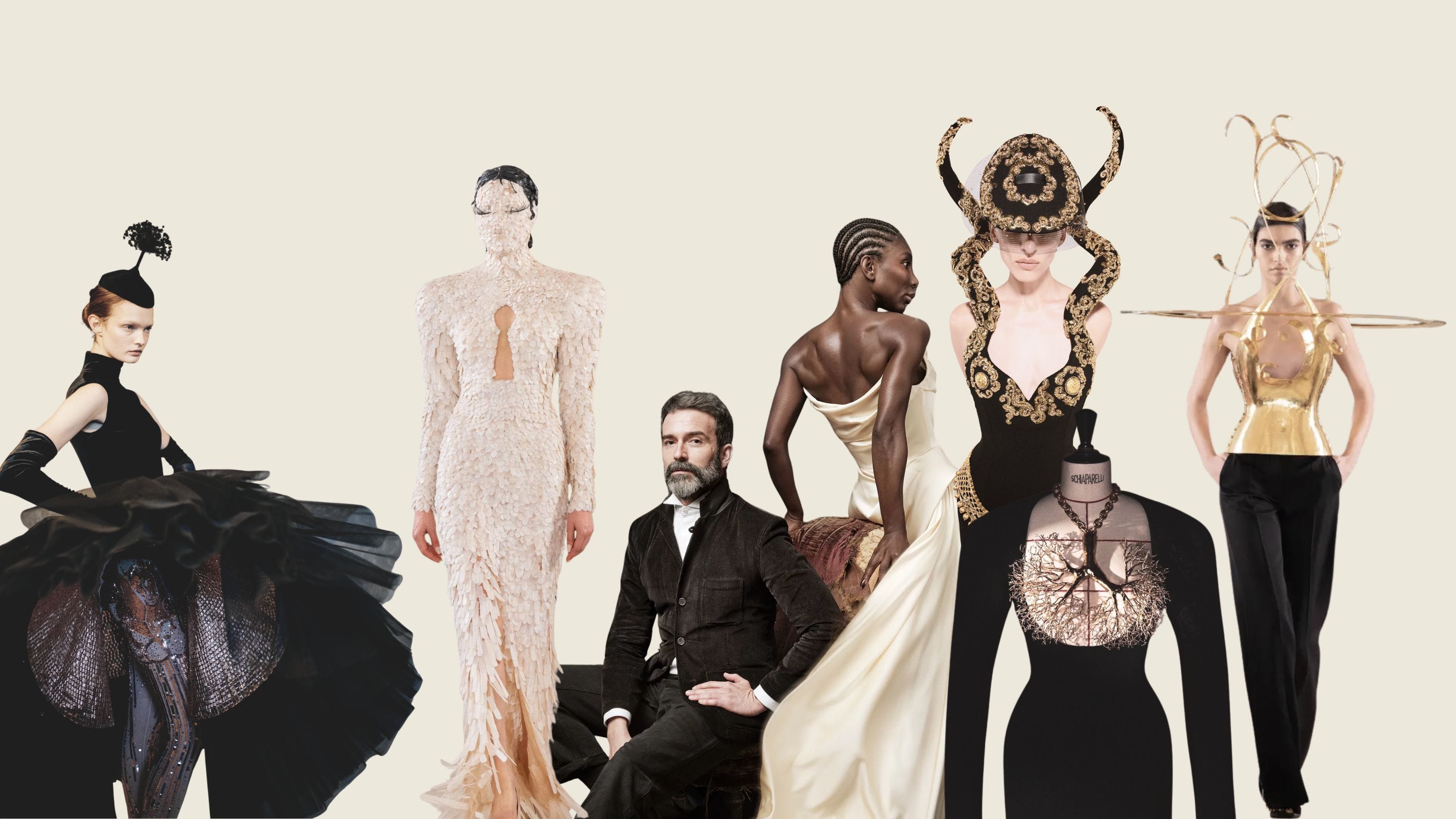
Hold onto that sentence, it is the very backbone of these musings.
Everything Roseberry has built at Schiaparelli runs on a single, increasingly rare resource: belief.
Exotic Animals and Audrey Hepburn
Daniel Roseberry was born in 1985, to an artist mother and an Anglican minister (his parents have almost attended every Schiaparelli show, deeply touching.)
Roseberry grew up in a Dallas suburb, amongst a intersection of religion and art, two systems of image-making that would later shape much of his work. Gagosian’s Summer 2026 Issue published an essay on Roseberry that has become one of my favorite records of his life, not simply his work. I will reference it often throughout.
His first commission, as a child, from a psychiatrist in his father’s congregation, paid him to fill the waiting room with drawings.
He drew exotic animals and a portrait of Audrey Hepburn.
Let’s sit with that—I would argue if you wrote that into a screenplay, the studio would send it back with a note that said too on the nose.
At nineteen, Roseberry traveled on mission trips to Jordan, Pakistan, and Israel. For some time, he came remarkably close to becoming a minister himself. When Roseberry went to a Pennsylvanian seminary, the dean who interviewed him stated, “You have to go to New York…You have to chase your dreams.”
Daniel Roseberry did not trade one faith for another, rather, he brought his capacity for devotion into an industry desperately in need of it. Before we leave Rosberry’s beginnings into fashion behind, one more piece to complete the picture:
A 2000s Style.com documentary about a Michael Kors show—Tim Blanks and all. Roseberry cites it as the moment his desire to become a Disney animator shifted into the universe of fashion.
Somewhere in an alternate world, there is a Roseberry-directed princess movie, and honestly, the costumes would have been insane.
The Ghost of Elsa
In 1927, Elsa Schiaparelli founded her namesake. The Lobster Dress, the shoe hat, the skeleton dress—a universe steeped in surrealism, Dalì himself was a regular collaborator. Coco Chanel passively referred to Elsa as “that Italian artist who makes clothes.”
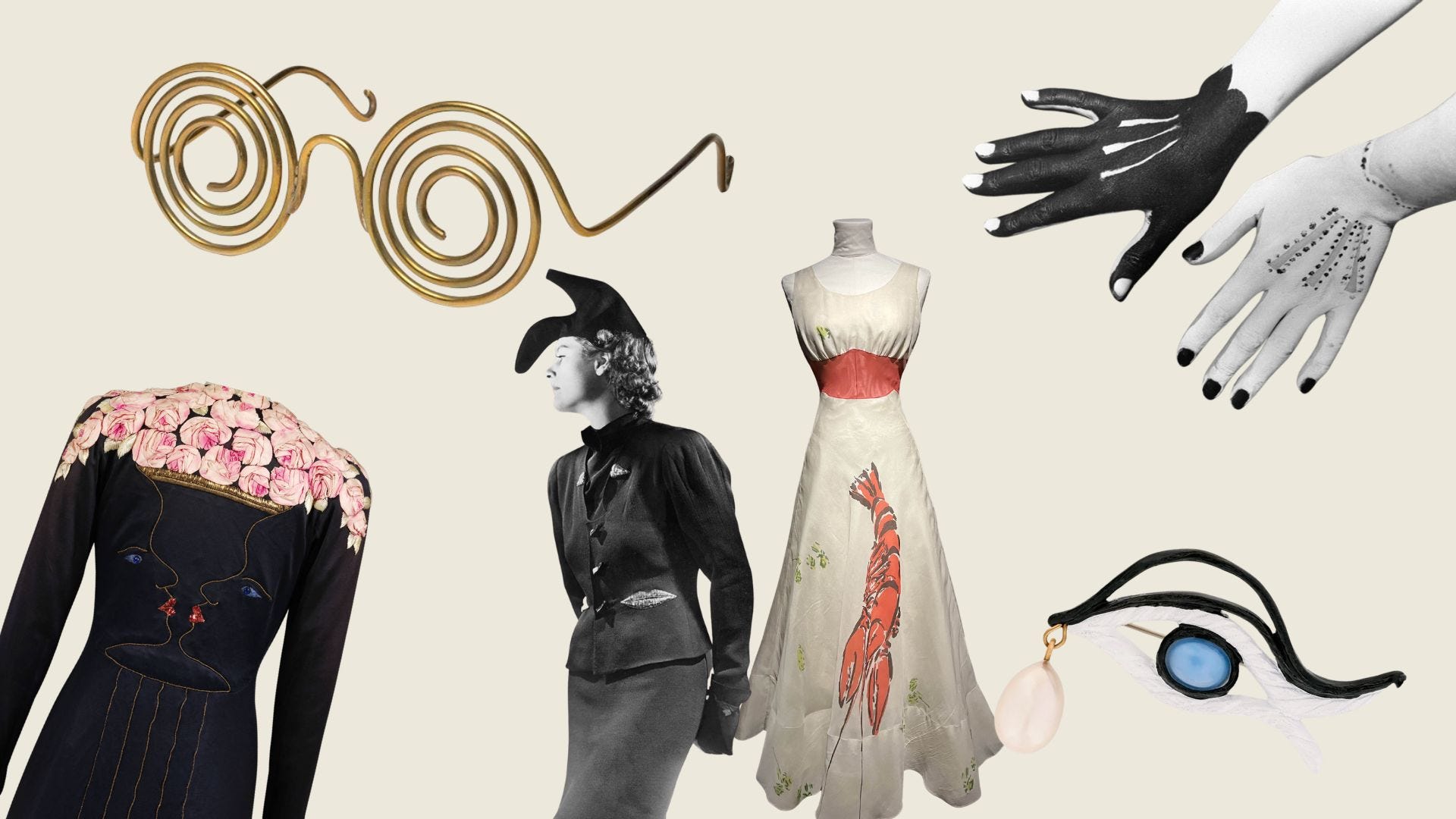
This may have been a dismissal—ironically, it has aged into an incredibly accurate description. Elsa was never running adjacent to Surrealists, she was part of its body. Every designer who has since considered whether fashion can be art, is as Roseberry himself has said, one of her children.
After a decade at Thom Browne, Daniel Roseberry was named creative director of Schiaparelli in April 2019. Italian billionaire, Diego Della Valle, had purchased the name in 2006. (The man behind Tod’s). A 33-year-old Texan who had never worked a day in Haute Couture and spoke no French, would be the first American to ever lead a French couture house.
He showed his first collection two months later, placing himself in the middle of the runway, sketching as models walked around him. Critics loved it. There is something almost disarming about how Roseberry believes in what he creates—how he renders any questioning of fashion’s artistic form, truly obsolete.
Roseberry’s debut drew enormous attention, yet he ignored the questions that spectators were most eager to learn: Who is the Schiaparelli woman, and where are the artist collaborations? It was bravery over homage, with the intention of chasing her spirit rather than the archive. There was no exhumations of Elsa’s greatest hits or a rent-a-Koons partnership. Principled as it was, there was simply no archive to tangibly reference—Elsa gave it nearly all away to museums and institutions before the house went dormant in 1954.
Preservation by Innovation
To understand what Daniel Roseberry has built, we must look at the grammar.
The first visual syntax to observe is the body: cast in gold, often fragmented. Ears, eyes, nipples, lips, toes, lungs—placed on the body as autonomous features, in the shape of jewelry and ornament. The Surrealists made a movement of dismembering form; think Dalì’s Venus de Milo with Drawers, Magritte’s severed torsos. Roseberry’s interpretation arguably inverses: his lung necklace does not anatomize, rather, displays interior as treasure.
Gold is heritage—an homage to the buttons Alberto Giacometti made for Elsa. Rococo-framed eyes, bijoux noses and mouths. There are the famous gilded toe boots—akin to making Magritte’s The Red Model wearable, and a continuation of its narrative.
The trompe l’oiel lungs are the 1927’s bowknot sweater’s direct descendant, the same visual appliance: an illusion. The house’s first phantasm is the same as its modern-day posterity.
Roseberry’s Fall 2021 collection, The Matador, showed the depth of method. Bull-horns spun into shoulders, a chandelier jacket embroidered entirely with vintage crystals. For all his ingenuity, Roseberry is fluent in the language of Schiaparelli. It is preservation dependent on innovation.
Consider the relevance and impact of Schiaparelli’s celebrity dressings:
Zendaya’s Odyssey look, Gaga’s 2021 inauguration gown (bulletproof, by the way), anything Celine Dion has worn, just to name a few. Under Roseberry, fame is not a crutch for visibility, but a form of continuity—merging Schiaparelli's visual world with popular culture. In an industry where red-carpet, or celebrity placement, are routinely contracted and soar above seven-figures, the house is yet to pay anyone under such practice.
That potency is inseparable from the larger picture: spectacle in serious dialogue.
In Roseberry’s January 2023 collection, Inferno, he referenced Dante’s nine circles of hell. Rather than relying upon the innate theatricality of the poem, he reinterpreted its contents as an allegory for a psychic, violent need to make something from nothing.
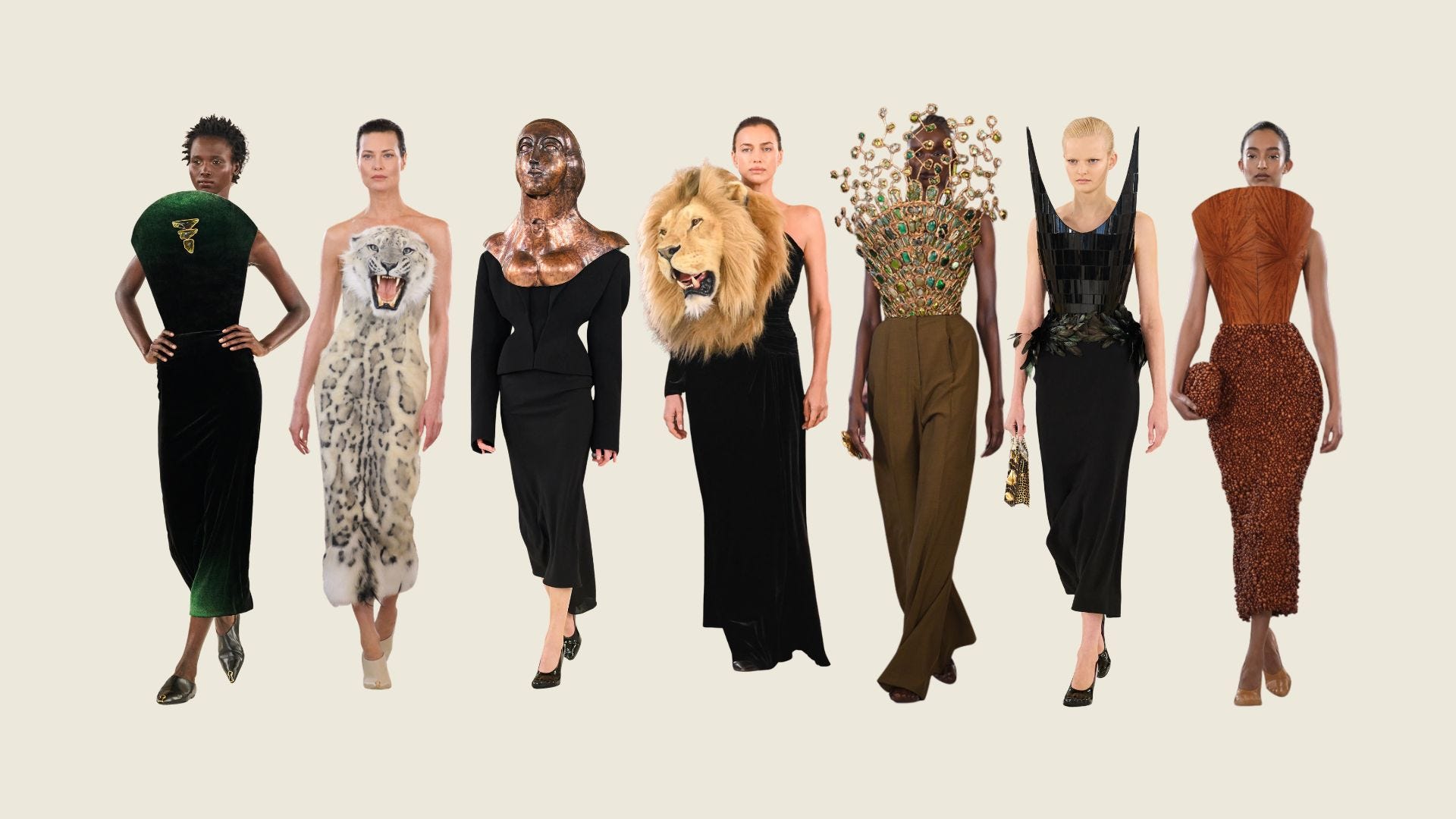
His show notes read as follows:
“…the torment that every artist or creative person experiences when we sit before the screen or the sketchpad or the dress form, when we have that moment in which we’re shaken by what we don’t know..Fear means you’re pushing yourself to make something shocking, something new”
“This collection is my homage to doubt. The doubt of creation, and the doubt of intent”
In other words, doubt and fear may be the most honest condition of art; an inevitable lack of stability, and a symptom of innovation.
No movement, no scale, mediated through our screens. Yet Roseberry’s creations strike rarity: the meaning is remarkably intact. This is no concession to the internet, however it is evidence of genuine authorship: an intent so precise, regardless of the medium, its vision remains assertive.
The Miniskirt
This spring, the V&A opened Schiaparelli: Fashion Becomes Art, a reconstruction of the archive Elsa had scattered across the world.
The exhibition is a visible representation of the kinship shared by Daniel and Elsa: Schiaparelli was never, at heart, a house of symbols. The lobsters, keyholes and anatomical themes are not authoritative. It is the vocation, an insistence that fashion bears the weight of meaning.
To turn the body into a canvas, a devotion to memory and innovation.
Ultimately? To foster a dream.
Roseberry recounted a specific interview with Elsa as both a reminder and warning: She was in her late fifties or sixties, expressing a disdain for miniskirts. Her failure to recognize provocation is ironic symmetry: even a radical imagination can harden into forms of tradition (without noticing it has changed sides.) Perhaps the goal, one that I believe Roseberry executes nearly flawlessly, is not to guard radicalism, but to keep it from hardening.
This is his real radicalism: a refusal to be embarrassed by conviction—the difficulty of commanding attention and sincerity, simultaneously. In Roseberry’s hands, excess and sincerity are not contrarians. They never were.
To quote Elsa Schiaparelli, “…in difficult times, fashion is always outrageous.”
One of her children—the minister’s son who kept the faith, sketching as though he is trying to remember something that hasn’t happened yet.
Elsa did not live to see her house revived, however, I suspect she would have immediately understood Daniel Roseberry and his bountiful creations.
Fashion is cultural evidence.
Musings on archival fashion, symbolism, and the systems of thought shaping how we understand beauty, history, and ourselves.
By Abi Hoffman
Sources & Further Reading
Gagosian Quarterly, David Roseberry's Substack, Wikipedia — Daniel Roseberry, Wikipedia — Schiaparelli, V&A — five things to know, V&A — Elsa Schiaparelli timeline, Schiaparelli — appointment announcement, WWD — exclusive on the appointment, WWD — Fall 2019 couture review, Schiaparelli — Giacometti bijoux, V Magazine — The Matador, WWD — Zendaya at The Odyssey premiere, TheWrap — Gaga's bulletproof gown, CNN — Celine Dion, queen of couture, Cultured — Roseberry interview, Office Magazine — Inferno, Art Fund — V&A exhibition, AnOther — V&A review