


Postmodernism is a cultural movement built on the deconstruction of traditional hierarchies and cultures via referential irony.
Postmodernism’s goal was not to discover truth or identify action, but to challenge the notions of a modernist’s frameworks. Borrowing recognizable symbols from the past, openly questioning whether anything can possibly be original. Through a postmodernist lens, history is not something to necessarily preserve but to distort, reference, and reassemble.
“The ultimate language of madness is that of reason”
Michel Foucault
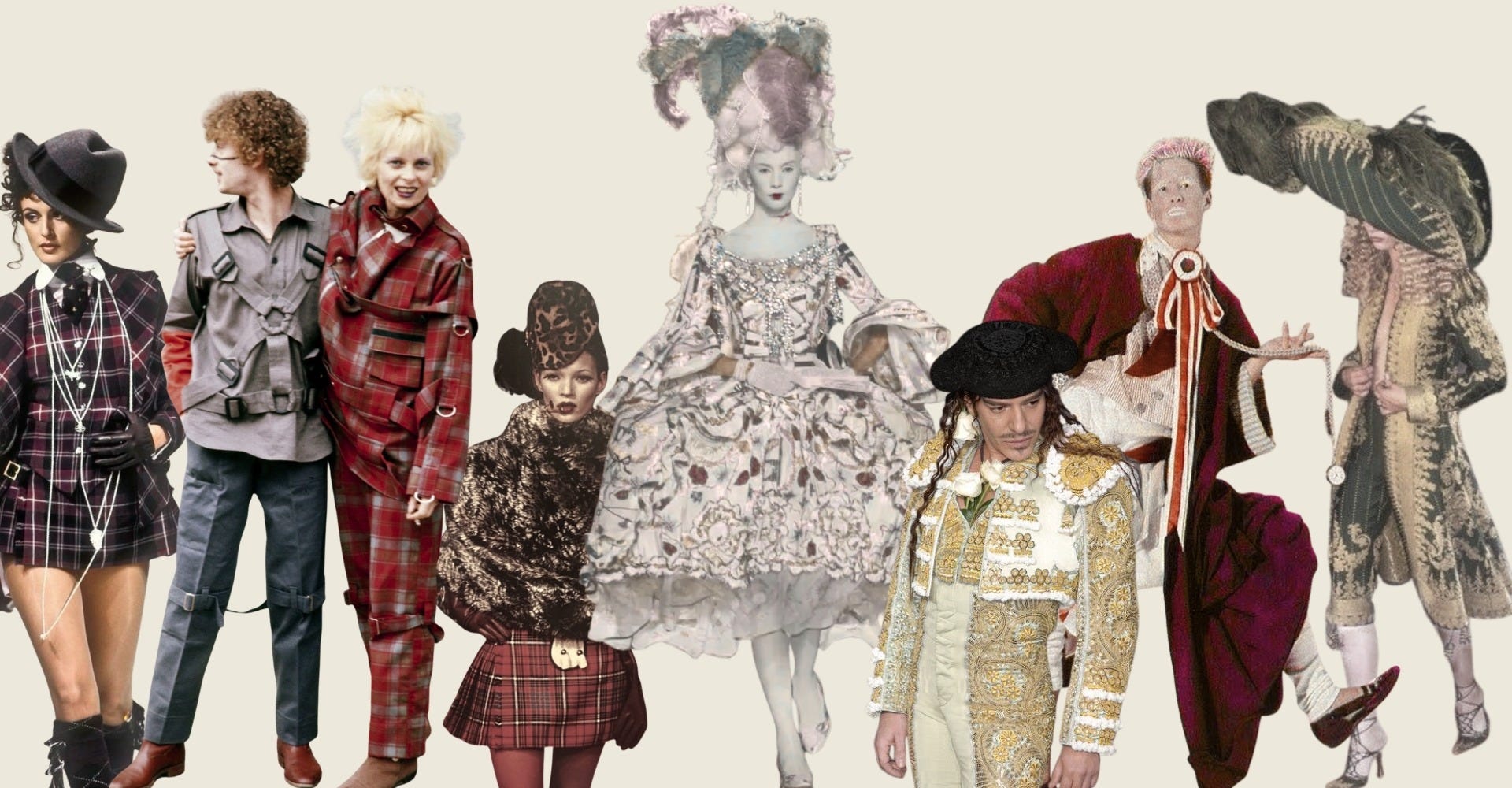
Vivienne Westwood & John Galliano
The Insurgents
A corset is punk, a logo is both the joke and a sellable product. It is inversion and humor alike. At its peak, postmodernism behaves like a fracture. It loosens modernism’s obsession with ideals, purity, and “newness.”
Punk was an early manifestation of deconstructionist fashion, Vivienne Westwood developed her logic through corsetry and tartan; a subversion of British style. Westwood’s disruption was not simply an aesthetic, but the whole method. Westwood turned from tearing clothes apart to raiding history itself, she would spend hours at the V&A’s archives, inspiring warped interpretations: a Victorian crinoline into a mini skirt, corsets inverted. Her tartans took British identity and restyled it into provocative pieces.
If Westwood weaponized the archive, John Galliano entered into a love affair with it. In his graduating collection at Central Saint Martin in 1984, entitled “Les Incroyables,” Galliano revived the extravagant dandies of the French Directoire in furnishing fabrics, collapsing post-Revolution Paris into the theatrical excess of London’s 1980s club scene. Galliano was feverish, his sketchbooks were filled with juxtaposing histories. In 1996, when Galliano took the helm at Dior, he treated the house’s archive less as inheritance and more like a hallucination.
Fashion historian Caroline Evans framed it as a tension between modernity and spectacle. This was postmodernism at its most operatic: history rendered so theatrical it became atmospheric. Galliano’s fantasias shocked because couture still largely operated under an expectation of tradition; it was a postmodern demonstration of how archives could become unpredictable.
Alexander Mcqueen, Yohji Yamamoto and Comme des Garçons also employed postmodernist conceptuality in their work—we could discuss for hours. For the sake of the argument itself, let’s continue.
When the Wall Disappears
Irony draws its power from contrast, defying the expectations of seriousness.
Akin to graffiti sprayed across walls without permission.
What happens when that wall disappears entirely? No seriousness left to pierce, no taste left to offend? If irony is no longer the exception to culture, but is culture itself?
A joke told into a room where everyone is joking—that is where I have landed.
Over the past four decades, postmodernism has become the condition: Y2K returned before it had time to pass, the 1990s are rediscovered, fatigued, and rediscovered again. Consider the number of re-editions, subculture revivals, and silhouettes reissued we are presented with in modern-day.
The archive has become its own circulating system.
Let’s consider other artforms. Reboots, legacy sequels, films about films. In music, songs are largely built from samples and interpolations of songs that were samples themselves.
Nostalgia is no longer a mood, rather, an infrastructure.
Ghosts, Jokes, & Gold
This does not render all present creations empty, some of it has been brilliant. Demna’s Balenciaga grasped the absurdity of luxury’s interior, Alessandro Michele’s Gucci was a cabinet of curiosities. But when everyone is quoting, it becomes the default.
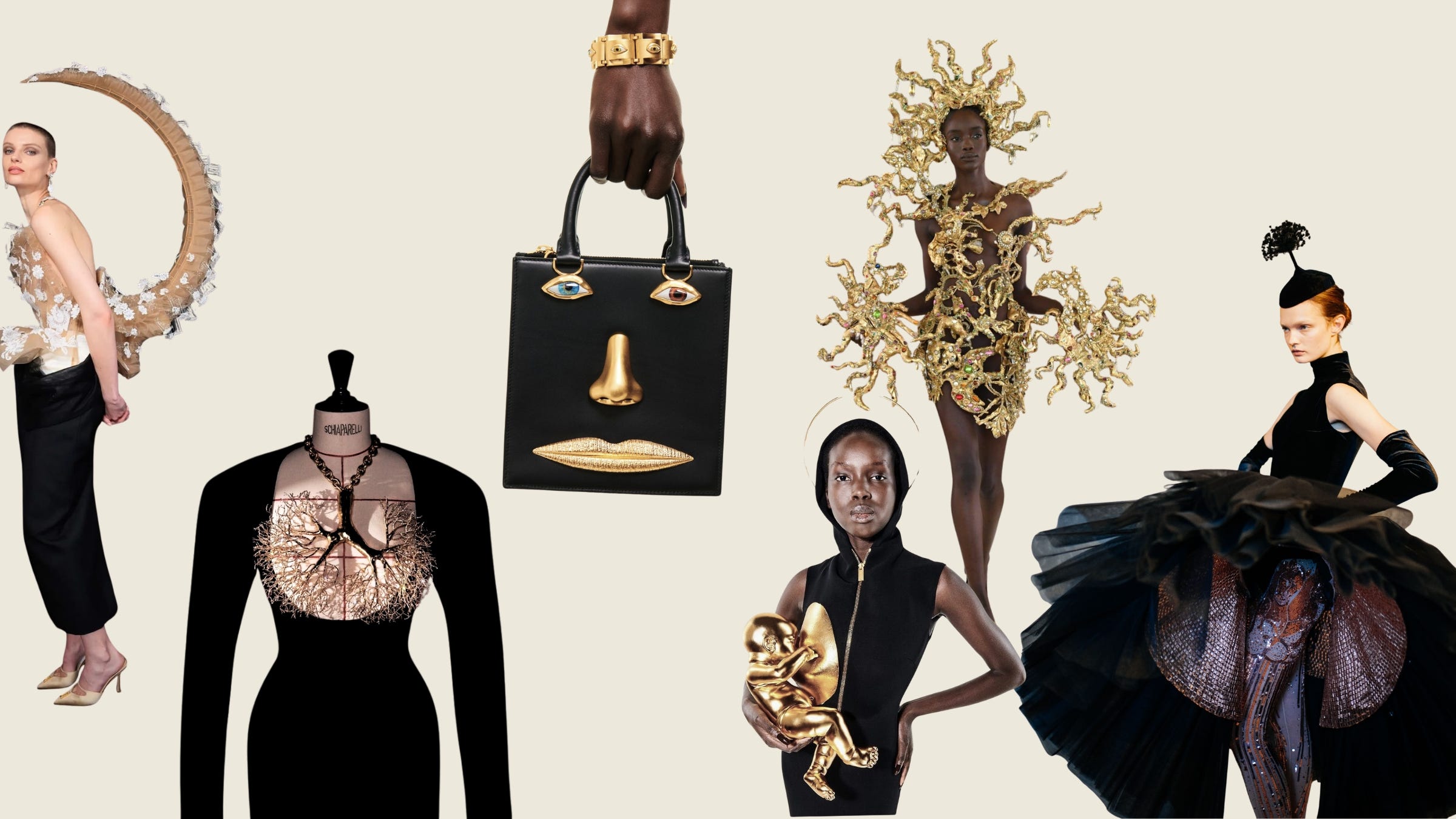
Daniel Roseberry’s Schiaparelli
Daniel Roseberry’s Schiaparelli offers an instructive counter.
His work does not abandon reference, but it is of the refusal that reference is its main body of work. Surrealism, gilded body parts, excess could collapse into a postmodern spectacle, yet Roseberry’s register is not ironic. He utilizes the archive to become original: wonder, fantasy, devotion are derived from his sincere, and modern interpretations. Roseberry insists that originality can live inside history without remaining in its shadow; the answer to referential exhaustion does not have to be silence, beige, or purity.
Imagination made serious again. Spectacle disciplined by craft, a fantasy that is not only reference, but possesses authority.
Automated Gestures
Technology intensifies the drift away from originality. Our social media feed’s are postmodernism’s ideal: a Margiela runway still, a Y2K Paris Hilton and Nicole Richie pap shot, a Renaissance portrait, and an AI render arrive in the same scroll, stripped of chronology.
The algorithm does not simply show these at once, but trains the eye that they belong together, flattened.
What postmodernist designers did intentionally, splicing contexts, is now done by default a billion times a day. Recombining references sans belief, memory, or rebellion, and producing the very condition postmodernism once had to theorize, on demand. Now before I risk sounding like a grumpy traditionalist, my point is:
A gesture any machine can perform endlessly may have no mystique left to lose.
Postmodernism’s philosophy became embedded in our culture’s language in totality; a strategy cannot remain disruptive once it becomes the air we breathe.
“Quiet Luxury”
One counter-movement has taken a quieter shape, a draw toward garments that do not announce or perform. This is what makes discourse around “quiet luxury” particularly interesting, it is almost less of an aesthetic, more so, a symptom. After years of fashion speaking via logos, jokes, and revivals, the silent garment starts to feel aggressively unique.
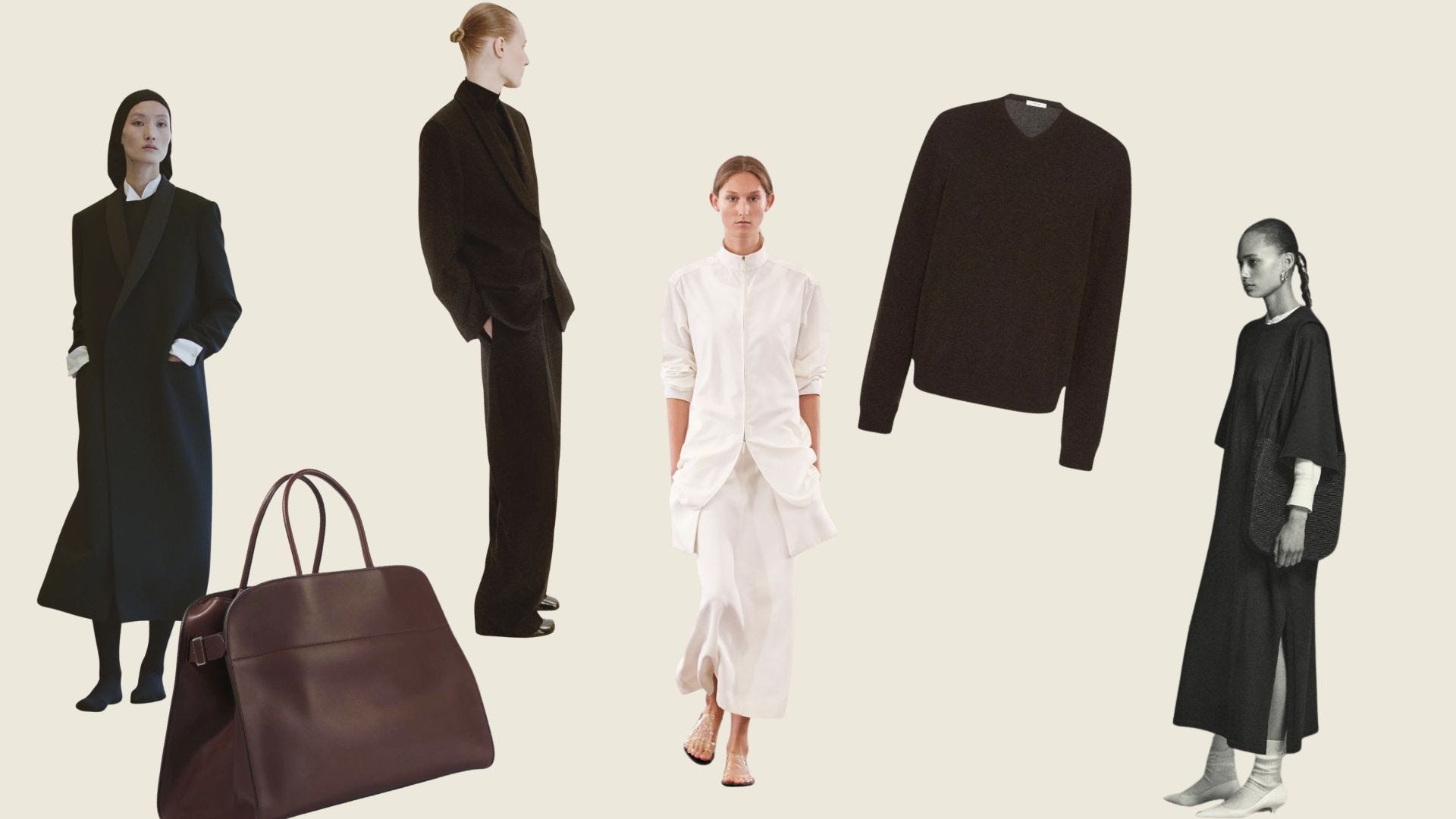
The Row is useful here as a cultural object. Conversation surrounding it can easily collapse into “overpriced basics,” which is not entirely wrong, nor remotely sufficient. If a piece of clothing is simple yet expensive, what is one paying for? Exclusivity? The fantasy of refusal? In a culture fueled by reference, the absence of obvious becomes its own movement—which is to say, its own reference. The refusal is clear against the noise it refutes.
Restraint becomes recursive: silence as a style, quoted in turn.
Still, The Row is indicative of desire, or curiosity, for fashion that does not depend on immediate pleasure of recognition. A sweater has no need to cite six decades at once, yet it can still spark debate, even if it is only regarding whether they are beautiful, absurdly priced, or both.
Restraint is not necessarily the answer. Our appetite for authenticity still arrives pre-mediated. Filtered through images, references, virality. “Quiet luxury” circulated as a viral aesthetic before most of its adherents could spot a Margaux bag. Literalness can be aestheticized as quickly as irony. The question is no longer whether fashion can destroy the idea of the original; that battle has been won, or lost. (Dependent on your appetite for collapse.)
The pressing question, the one I ponder myself, is what fashion can do when endless recombinations stop feeling like rebellion or freedoms, and become habitual?
Many Mirrors
Perhaps the next movement will not arrive as a rejection of postmodernism, but as a decision to outgrow its reflexes. It may ask a different question entirely.
Can we carry weight beyond references?
If every image is an image of an image, inversion becomes involuntary. The alternative does not need to be innocent or minimalist in its totality. It may be something more demanding: working with enough internal force that allusions no longer have to carry the value.
A possibility that after decades of mirrors, fashion might once again become interested it what it can do without them.
Fashion is cultural evidence.
Musings on archival fashion, symbolism, and the systems of thought shaping how we understand beauty, history, and ourselves.
By Abi Hoffman
Sources & Further Reading
Explaining Postmodernism by Stephen Hicks
Vivienne Westwood & Postmodern Punk
John Galliano “Les Incroyables”
John Galliano: Modernity & Spectacle
Can Hollywood Sequel Its Way to Box Office Success?