

“My dear Christian, your dresses have such a new look!”
Imagine.
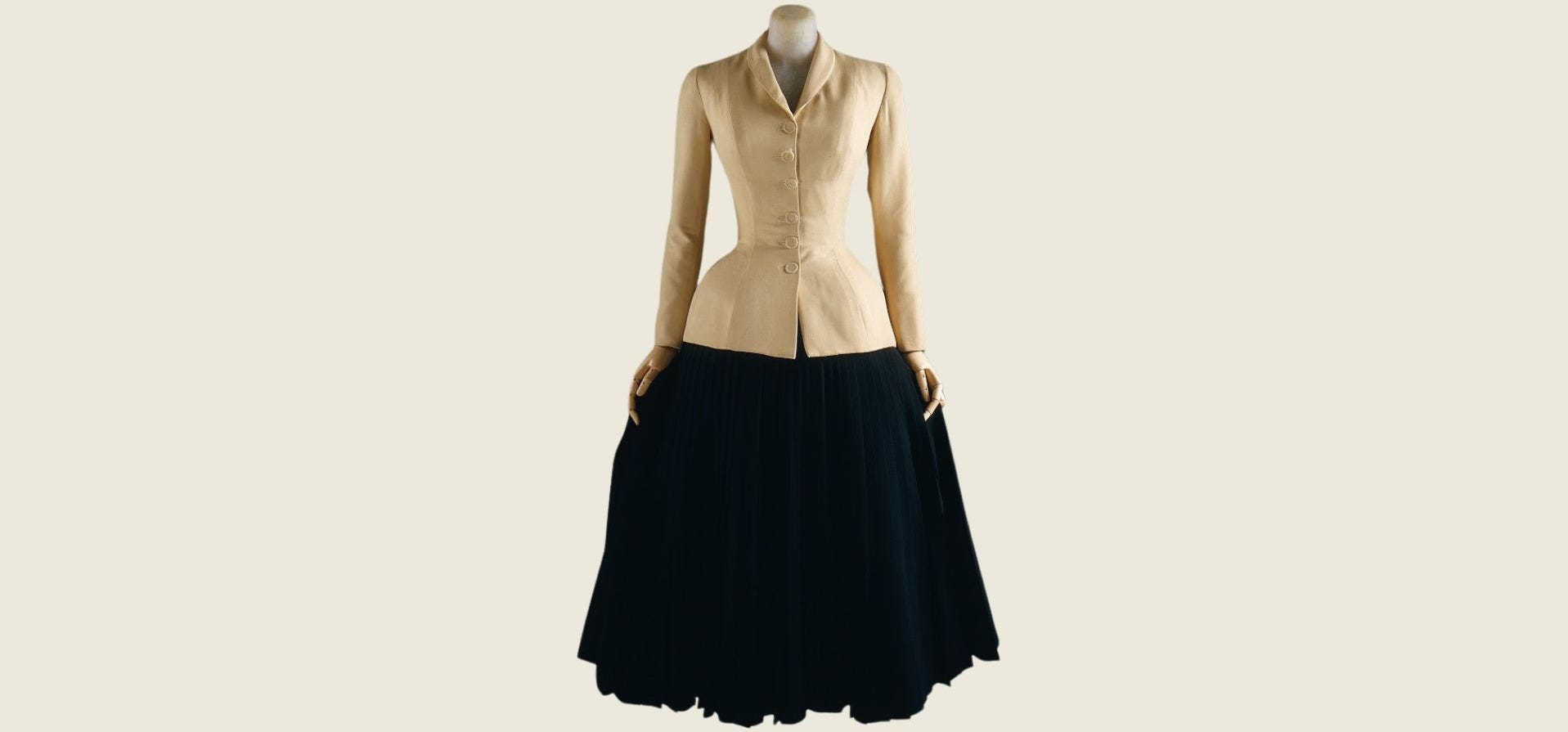
It is the morning of February 12, 1947, Christian Dior sends ninety looks through the salon of 30 Avenue Montaigne.
Outside: one of the coldest winters of the century, bread rations bound for 250 grams a day.
Inside: Carmel Snow of Harper’s Bazaar, watching twenty yards of fabric sweep by in a single skirt.
In Britain, clothing coupons held until 1949, three coupons to the yard. A single Dior skirt cost more than the entirety of an annual ration. Late-1940’s Europe was plagued by post-war austerity. The New Look was a quantified reckoning on public platform.
Each yard represented a declaration: hardship had ended for those who could afford it.
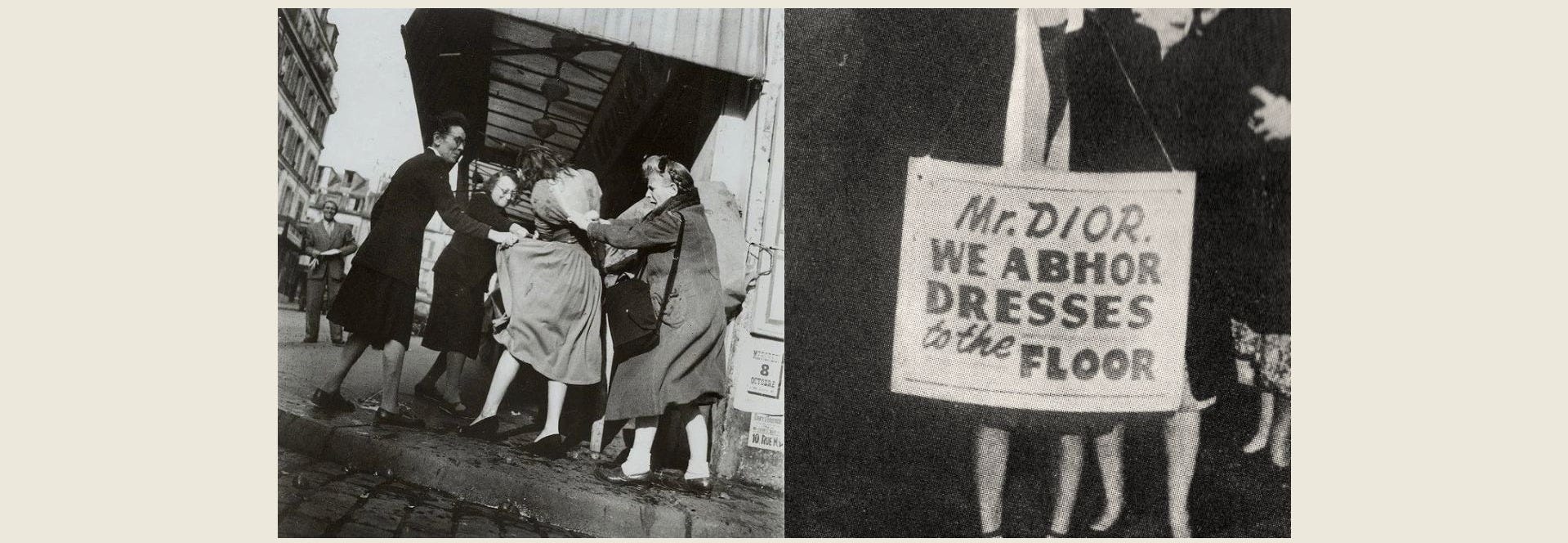
Left to Right: Parisians rip Dior Dress off Model & the Little Below the Knee Club protestors
The Fury
The New Look was an active depiction of who had earned the privilege to abandon struggle.
In October 1947, a campaign shoot on Rue Lepic in Monmartre staged a deliberate paradox: couture against cabbages. Women of the market, outraged, set upon a model and tore the Dior look from her body.
In Dallas, ex-model Bobbie Woodward founded the Little Below the Knee Club, which swelled to 1,300 members and inspired chapters nationwide. They marched under banners reading “Mr. Dior, we abhor dresses to the floor,” and, with a distinct Texan resolve, “The Alamo fell, but our hemlines will not.”
Government officials joined the discourse. Sir Stafford Cripps, President of the Board of Trade, declared “the shorter the skirt, the better” whilst Britain remained desperately short of fabric.
Dior suggested revival, critics argued waste.
In his autobiography, Dior by Dior, the New Look was posed as rejection of the form that war had imposed.
“We were emerging from a period of war, of uniforms, of women-soldiers built like boxers,” he wrote. “I drew women-flowers: soft shoulders, fine waists like liana, wide skirts like corolla.”
Dior’s counter: beauty does not wait for permission from suffering.
“The neglected art of pleasing.”
The Economics of Surplus
Let’s look at a philosophical account of these stakes.
Two years after the New Look’s debut, Georges Bataille published The Accursed Share, a masterwork of economics, arguing that the fundamental problem of any society is not scarcity, rather, surplus. Every economy generates more energy that it can use, and the excess must be spent, “gloriously or catastrophically.”
Glorious: cathedrals, festivals, jewels. Catastrophic: war.
A society that had just consumed its surplus through devastation was therefore left with the question: What would it choose to lavish upon next?
Interpreted in this lens, the New Look is not an aberration of 1947, but its mirror. Europe had expended a decade of excess in munition, Dior proposed expending it in silk. Twenty yards of fabric were not incidental, it was an argument.
The Parisians on Rue Lepic did not misunderstand Dior’s intent. They understood it perfectly.
(That was the problem.)
Women had been dressed for endurance: squared shoulders on a factory floor. Dior asked them to return to an architectural display: cinched waists, skirts ever-consuming. Chanel, who had built her maison’s DNA on combatting this very silhouette, stated Dior “doesn’t dress women, he upholsters them.”
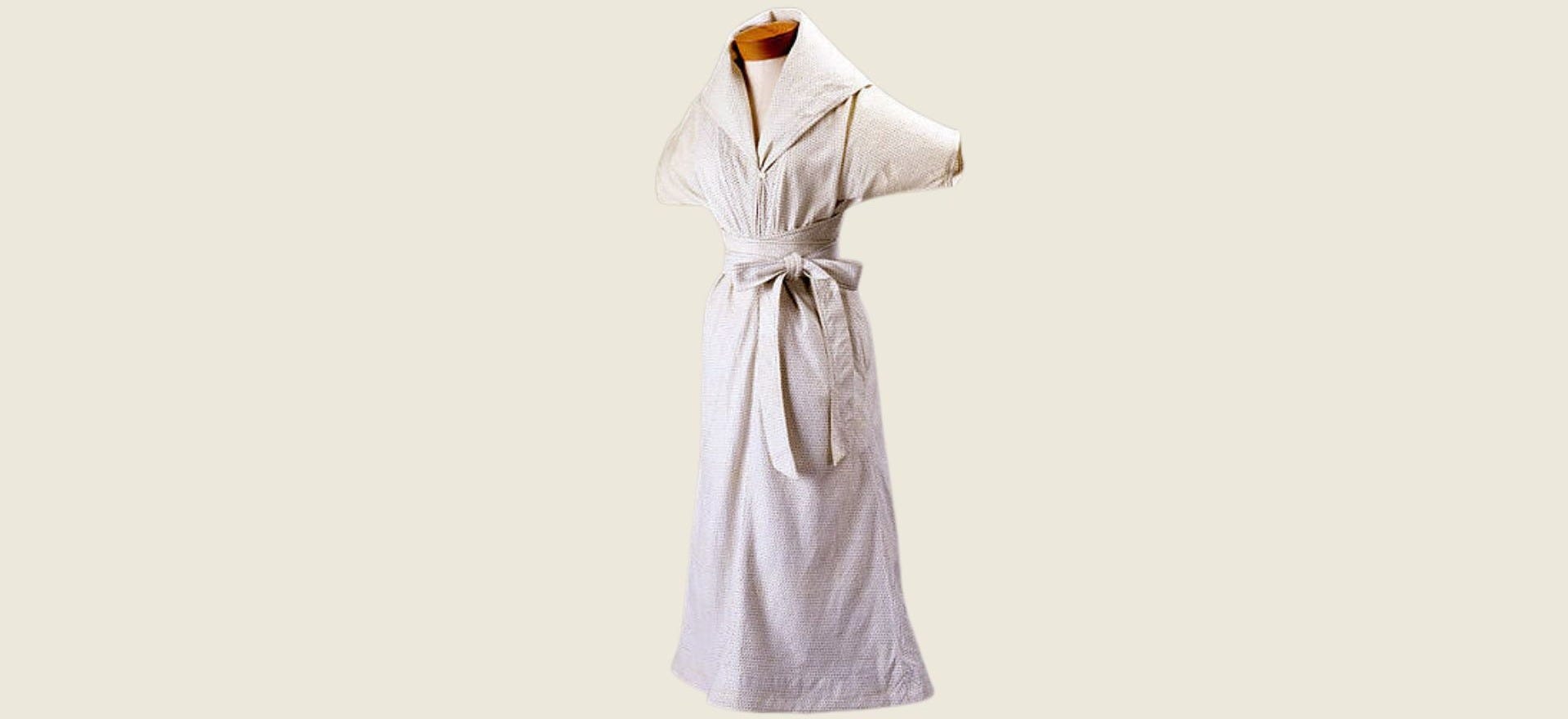
The Popover Dress
The Seven-Dollar Opposition
Claire McCardell offered a different response to societal load: The Popover, a wrap dress composed of denim, deep pockets, and an oven mitt buttoned at the waist. It sold for $6.95. Over 75,000 moved post-release.
McCardell did not regard shortages as an obstacle to design.
There is a philosophical nature to the contrast of these designs. Dior intended relief through a vessel of escapism, McCardell made freedom synonymous with utilitarianism.
A Dream and Its Consequence
It is tempting to score this as a moral contest and hand McCardell victory, the Popover was democratic and practical.
However, it is a verdict that flatters the instinct to see utility as most virtuous, missing what Dior understood. Subsequent to deprivation, beauty and extravagance could remind society that reality was capable of change.
People crave more than survival. An image can serve as proof that life is still desirable—hunger is not only physical.
Protests collapsed quickly, within two years the Little Below the Knee Club evaporated, its members were wearing the hemlines they marched against. The desire had persisted, waiting for someone shameless enough to dress it.
McCardell’s counter keeps the story honest: beauty that ignores the conditions of the people can curdle into cruelty.
The New Look and the Popover confide in fashion’s moral intelligence. Simultaneously interpreting what a society has survived whilst proposing what it can become.
Bataille would say the surplus gets spent either way, the choice lies in what we make it look like.
Does fashion reveal the future a culture desires, or dress the present it cannot bear?
Fashion is cultural evidence.
Musings on archival fashion, symbolism, and the systems of thought shaping how we understand beauty, history, and ourselves.
By Abi Hoffman
Sources & Further Reading