


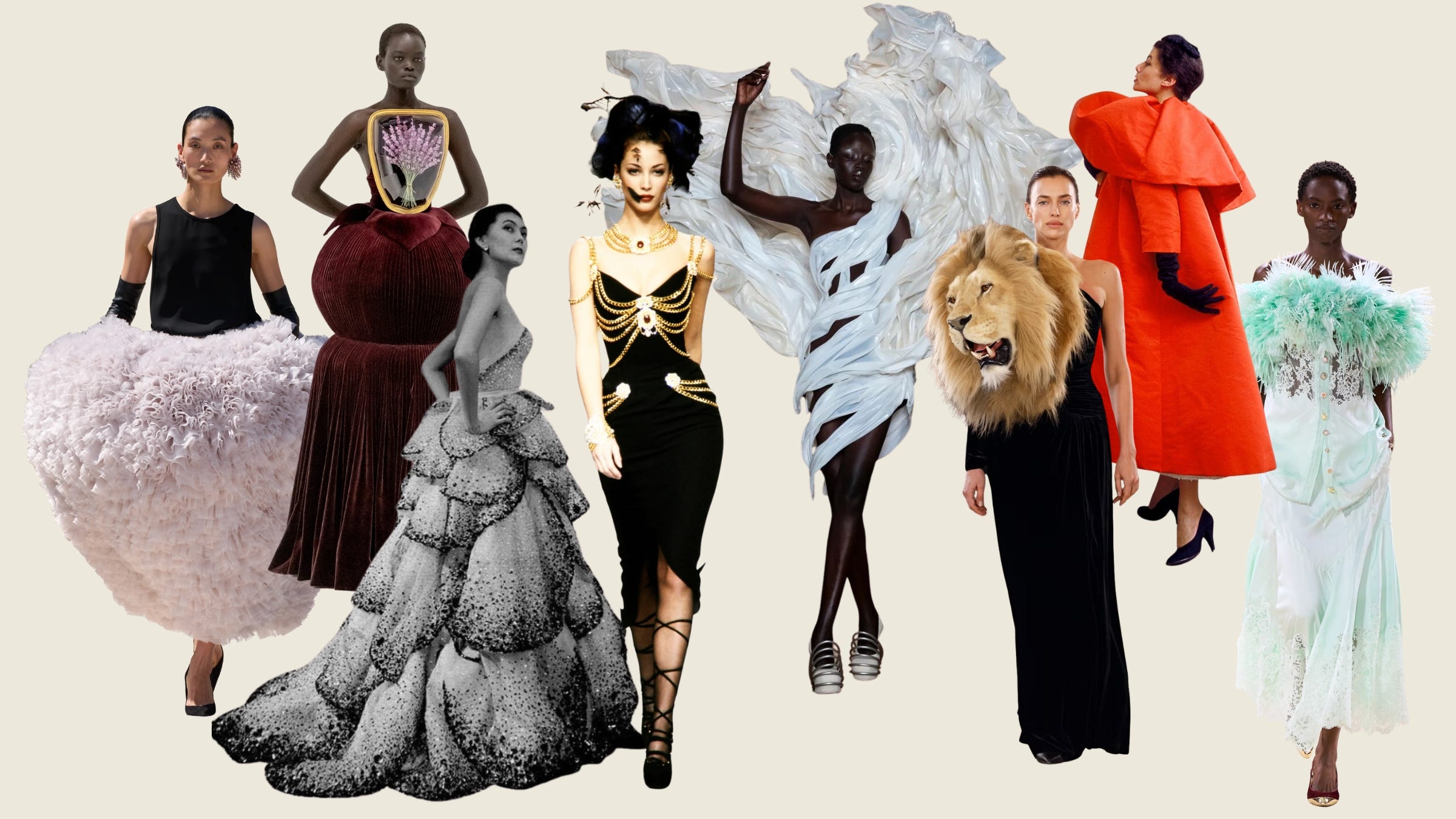
Haute Couture is the industry’s most splendid form.
Clothing leaves the logic of commodity and enters the logic of art.
It is financially irrational, materially excessive, functionally unnecessary, it remains essential because fashion still needs dream fuel, where it can pretend to not be commerce.
Fashion’s most transcendent form has become the dream through which everything else is sold.
Can couture preserve the integrity of its origin when its modern function is promotional?
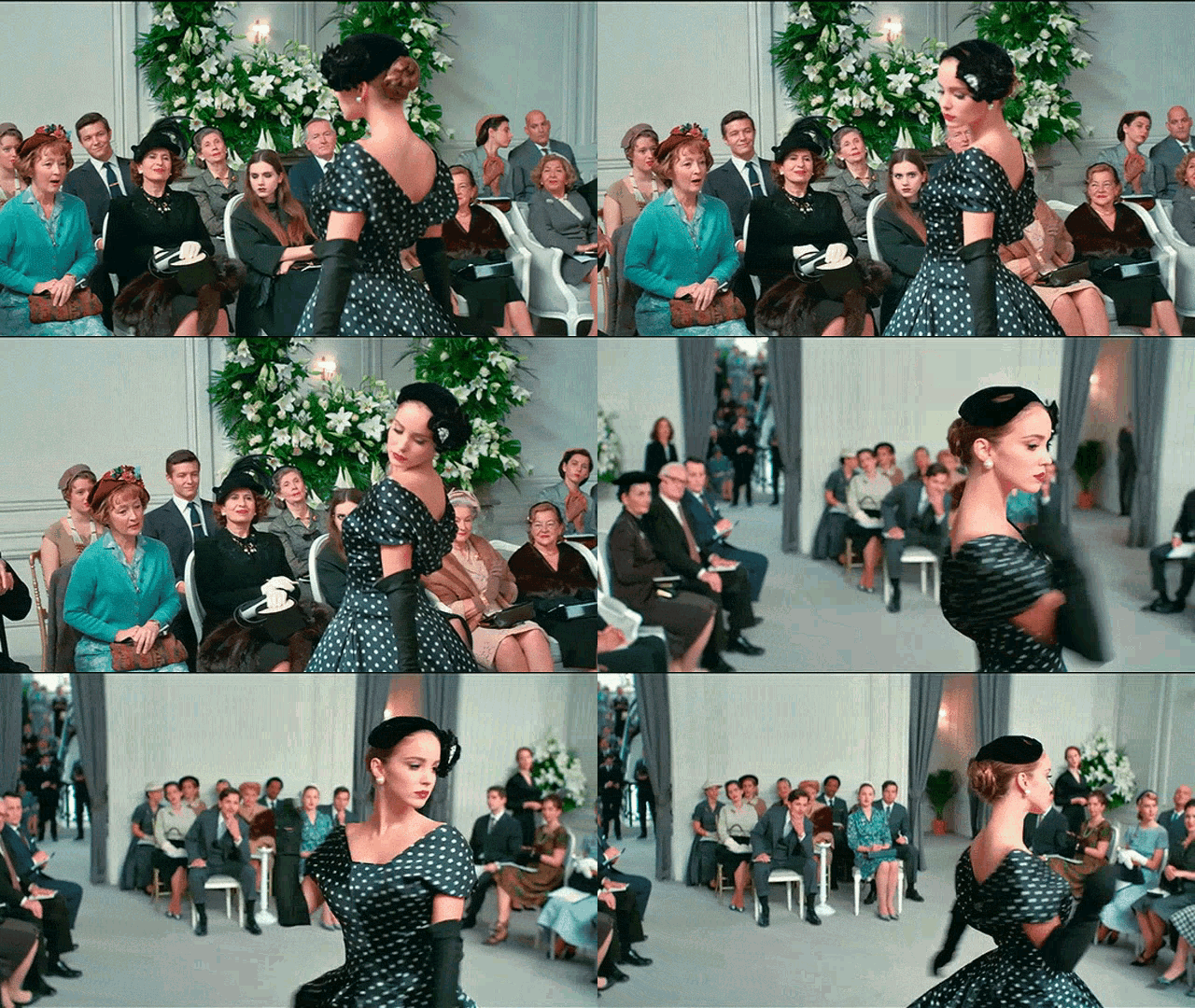
Mrs. Harris Goes to Paris
A film that follows a kindhearted London housekeeper chasing the dream of a Dior dress, only to discover that couture is not just about glamour, but hope, dignity, and the people who still dare to want something beautiful.
The Origins of Haute Couture
Haute couture emerged in nineteenth-century Paris through Charles Frederick Worth, who founded the first true couture house in 1858. Worth presented finished designs on live models, allowing clients to choose among his ideas and adapt them to their own specifications.
By placing his own name at the center of the garment, Worth helped invent the modern designer as a visible author—Cristóbal Balenciaga became Balenciaga, Coco Chanel became Chanel. Name itself became the source of a brand’s meaning, value, and identity.
A decade later, the Chambre Syndicale was formed to protect, regulate, and preserve the standards of the couture profession, laying the foundation for the Fédération as we understand it today. Couture was the language of elite life—salons and private clients; garments tended to with extraordinary attention to one body.
During the twentieth century, Chanel, Dior, Balenciaga, Givenchy, and their peers turned couture into both private wardrobe and public authority. Their work dressed a small class of women, but its silhouettes governed a much larger cultural imagination. Couture proposed not only what elegance looked like, but what femininity and modernity meant on a broader scale.
Ready-to-wear did not deaden couture; it freed it. Released from the obligation to dress its majority of clientele, couture became pure craft, fantasy, and expression. But a discipline with no practical function must continually justify its existence.
Couture has been answering for itself ever since.
The Changing Dream
The opening of Saint Laurent Rive Gauche in 1966 accelerated the separation of designer authority from high dressmaking, YSL proved a couturier could build serious fashion language outside the salon.
Luxury no longer depended upon individual commission; one could enter a house through the boutique. A designer’s vision became reproducible, distributable, and commercially scalable. Ready-to-wear absorbed the practical life of luxury—Couture inherited its metaphysical burden.
This was not merely an economic shift, it rewrote couture’s moral function. As ready-to-wear absorbed the practical life of luxury, couture was recast as the house’s highest expression: the imaginative horizon where craft, fantasy, and prestige could concentrate without regard for scale.
The salon had been built around the intimacy of one body, modern couture addresses a far larger audience, most of whom will never encounter the work beyond an image. Its purpose has become to generate desire at a distance.
The cultural shift worth examining is what role couture plays in a luxury world that is now largely met by ready-to-wear—the freedom that protects Couture also complicates it.
Image Economy
Today, couture is encountered first as image. Collections circulate through the feed, judged less by construction than by their capacity for spectacle. The irony is brutal: a garment that demanded thousands of hours is consumed in seconds.
Novelty trades as the highest value—the technicality and integrity of couture risks obscurity. A garment that shocks is rewarded before one that reveals itself through proportion, cut, craftsmanship.
Marshall McLuhan warned of this in 1964: "the medium is the message" the form through which content travels does not merely carry it, but remakes it in its own image. Couture now travels through a medium engineered for the three-second glance on a screen. A gown designed in the atelier but destined for media is, in McLuhan's terms, no longer quite a gown—it is content wearing one.
This is not to say spectacle is inherently hollow—couture has always thrived on theatricality, fantasy, and dramatic presentation. The tension arrives at a precise point: when visibility stops revealing the work and begins dictating its shape. As Vogue Business observed, couture functions as both an innovation laboratory and a powerful instrument of prestige. Its commercial worth was never in volume, but in the authority it confers upon the house: less profit, more dream.
It is the fantasy that makes a perfume, a handbag, a lipstick, the ready-to-wear feel touched by something higher:
Couture is the altar of its commercial machine.
The threat is inversion—the moment a gown exists in order to sell the lipstick, rather than the lipstick existing in the gown’s reflected light, the altar becomes a billboard.
(No one kneels at a billboard.)
Avant-Garde VS Couture
Matthieu Blazy's Spring–Summer 2026 couture debut for Chanel was built from transparency, muslin, birds, and the suit reimagined as "a second skin." Much of the commentary that followed measured the collection against avant-garde expectations. It's a useful mistake, because it reveals how thoroughly we've forgotten what couture is, and what it is not.
Couture does not prove itself through conceptual extremity. It is a licensed discipline, governed by the Fédération’s strict criteria, a system of sanctioned difficulty. Avant-garde is something else entirely: an attitude of rupture, existing to disturb form, material, and use. One is a system of making; the other is a position of refusal.
Couture can become avant-garde, it is not avant-garde by nature.
The confusion is understandable, and modern couture has helped create it. In an image economy, the quietness of construction is harder to communicate than a shocking silhouette. Concept travels faster than craft, couture increasingly borrows the avant-garde's language to justify its visibility.
The cost is subtle but consequential. Once couture begins to believe its value depends on appearing extreme, it mistakes one kind of difficulty for difficulty itself.
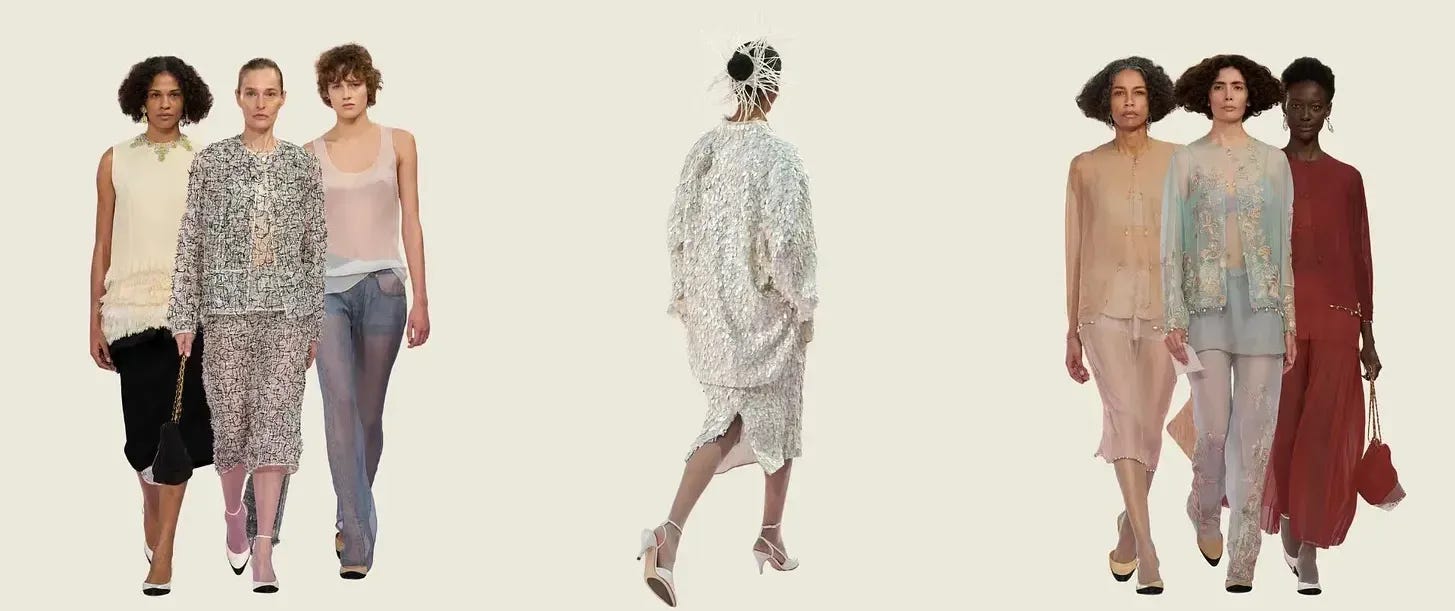
Chanel Haute Couture Spring-Summer 2026 by Matthieu Blazy
The Modern Function
The deeper question is not whether couture should be wearable, it has always exceeded ordinary use. The question is whether it still belongs to the body, or whether the body has become collateral.
A collection now moves straight from runway to exhibition, archive, vault, red carpet, feed. Witnessed, preserved, circulated—rarely lived in.
This is not automatically tragic. Some works should live in museums; fashion deserves rooms where impracticality remains sacred. But couture becomes unstable when the body disappears from its own purpose.
Couture has never been democratic and pretending otherwise only weakens the argument for its survival. The question was never exclusivity. It's whether craft still serves intimacy: answering to one body, a private exchange between wearer and atelier. At its best, couture defends hand against speed. At its weakest, it becomes luxury's exquisite alibi: the hand's devotion lent to bless the machine it was meant to resist.
Can couture remain faithful to its origin when its first audience is no longer the body in the atelier, but the screens waiting beyond it?
Blazy's answer was the suit as second skin—work made at the scale of one body, legible to the wearer before the audience. The future of couture does not depend on becoming louder, but by the reminder it can do the one thing ready-to-wear cannot: make fashion answer to time, touch, and impossibility.
Fantasy held without surrendering craft.
Couture’s real modern test is to stop exhausting itself in pursuit of astonishment and keep its truth alive after the world has turned it into an image.
Fashion is cultural evidence.
Musings on archival fashion, symbolism, and the systems of thought shaping how we understand beauty, history, and ourselves.
By Abi Hoffman
Sources & Further Reading
In 2019, Haute Couture Is Thriving
Does Couture Make Business Sense?
Marshall McLuhan, Understanding Media: The Extensions of Man (New York: McGraw-Hill, 1964)
Can it survive as image without surrendering to image? Can it be art without forgetting that its first medium is clothing?